
Physiotherapy
-
1 hour Physiotherapy initial assessment and treatment £90
-
30 min Follow up treatment £50
-
1 hour follow up treatment (for complex issues) £90
-
1 hour home visit £105
-
Phone/video 30 min Physiotherapy initial consultation and treatment £35
-
Phone/video 30 min follow up treatment £35
What is Physiotherapy?
Physiotherapy is the treatment of disease, injury, illness, disability or deformity by physical methods such as manipulation, massage, heat treatment, ultrasound and exercise rather than by drugs or surgery. Physiotherapy helps to restore movement and function.
Here at DirectPhysio4U, our physiotherapists use a variety of treatments to diagnose, treat, help heal you and involve you directly in your care.
All our treatments come under the umbrella of ‘physiotherapy’, have a look at our range of treatments and services.
We treat people of all ages and with a wide range of health conditions, such as bones, joints and soft tissue injuries. Rehabilitation and prevention are a part of our holistic approach to the whole of you.
Start the road to recovery with DirectPhysio4U by contacting us now for an appointment.
Rehabilitation
What is Rehabilitation?
Rehabilitation is the action of restoring someone to health or normal life through training and therapy after injury, operation or illness.
Our physiotherapist will first thoroughly assess your condition or injury, then they will provide you with advice to help you recover sooner. They will do this by educating you on improving or adapting your lifestyle and advising you on avoiding your injury from re-occurring.
Here at DirectPhysio4U, we emphasise the importance of our patients following our advice of exercises to maintain and further improve what they have achieved in their treatment.
What we provide you will be tailored for you and your condition or injury. You will be provided with an exercise sheet so you fully understand what is required on your behalf. We strive to support you every step of the way with your rehabilitation.
Acupuncture
Traditional Chinese Acupuncture
Acupuncture is one of the oldest forms of medicine, originating in China over 2000 years ago. It is believed that the body has channels (meridians) which contain the life force or energy, known as Qi.
When a person is in good health it is believed that Qi flows freely and there is a balance of positive and negative. When a person is in pain the channels (meridians) are blocked and it imbalances the body and interrupts the flow of Qi. The Chinese believe that the balance can be restored through acupuncture.
Acupuncture needles are inserted into the body at specific points along the channels (meridians) which promotes the production of endorphins (natural pain killing hormones) and stimulates the nerve fibres the prevent pain messages reaching the brain
Acupuncture may be offered as part of your treatment alongside exercise, joint mobilisations and rehabilitation. There is good and sound evidence for its use and the western medical profession has accepted acupuncture as part of treatment for patients with pain. The National Institute for Health and Clinical Excellence 2009 (NICE) have recommended that acupuncture should be available as a cost-effective short-term treatment for persistent non-specific low back pain. Acupuncture also has other benefits such as improvement of sleep, relaxation, sense of wellbeing, improved energy levels and reduction of painkillers.
Your Physiotherapist will suggest if acupuncture will be effective following the assessment. There will be some patients where acupuncture will not be used for medical and safety reasons. In most cases acupuncture can be used with patients with medical problems but with caution
The treatment involves using sterile single use needles which are inserted quickly through the skin. The needles will be inserted along the channel (meridian) depending on your painful area. Your Physiotherapist will decide on how many needles you require and they are usually left in for 10 – 30 minutes. Your physiotherapist may gently stimulate the needles to attain the feeling of De Qi (energy) during the treatment. The whole treatment will take about 40 minutes.
Research has suggested a course of six to ten treatments to achieve the best results.
If you have any concerns or would like more information please do not hesitate to contact us.
Trigger Point Acupuncture (dry needling)
Trigger points (hyperirritable and hypersensitive knots) are contractures of fibrous bands. Trigger points can be found in muscle, tendons, capsule, ligaments and skin. When a trigger point is felt, the patient flinches due to the pain.
They can be caused by poor posture, excessive heat, cold, damp and draughts, injury, sustained positions, bad habits and immobility.
Trigger points may be found in two different phases:
Latent phase – does not cause pain, found in symptomless people.
Active phase – activation so strong that pain is referred locally and/or away from the area.
Our physiotherapists are also trained to treat trigger points with acupuncture needles. This involves stretching the skin slightly and placing the needle into the trigger point, aiming to get the needle into the tight/hypersensitive band. This may stimulate a painful response and the needle is left in for 1 – 3 minutes.
Occasionally only one treatment is needed and in some cases more sessions may be needed depending on the number of trigger points and the size of them.
If you have any concerns or would like more information please do not hesitate to contact us.
Manual Therapy
What is Manual Therapy?
There are two types of Manual Therapy.
Manipulations are a high-velocity low-amplitude (HVLA) thrust. Therapists use their hands to apply a controlled sudden force to a joint while the body is positioned in a specific way. Manipulations often results in an audible “pop”.
Your Physiotherapist will make the decision of using a manipulation or manipulations after a thorough assessment. Manipulations can be used for nearly all joints however they are not used with all patients especially those with weak bones (osteopenia and osteoporosis), inflammatory conditions (rheumatoid arthritis) and those who may have underlying pathology.
Talk to us about manual therapy if you are interested in knowing more.
Mobilisations are low amplitude movements to joints. These can be used on patients with weak bones (such as osteoporosis), inflammatory conditions, pathology or patient preference who may require a gentler approach. In addition, some patients and/or clinicians prefer mild spinal mobilisation techniques that do not involve twisting of the body or a forceful thrust. Mobilisations are carried out in most of our patients due to the gentler and still very effective approach.
Talk to your Physiotherapist for information on these techniques.
Ultrasound
Ultrasound
Ultrasound is a form of treatment, which uses small electrical impulses to repair tissue, stimulate muscles and increase sensations and muscle strength. There are numerous electrotherapy modalities used by physiotherapists however in our opinion the most effective modality is ultrasound and TENS (transcutaneous electrical nerve stimulation).
Ultrasound uses sound waves to speed up the healing process whilst TENS reduce pain by manipulating the nerves, which reduces the sensation of pain and produces a tingling feeling.
The benefits of electrotherapy are the speeding up the healing process, improving the circulatory system, increasing muscle tone, reducing pain levels, increasing strength, increasing range of movement, increasing speed and strength of muscle contractions and increasing rate of absorption.
Ultrasound is used for injuries and conditions that have caused swelling and pain such as ligament sprains, muscle injuries, tendon injuries or tendonitis.
Ultrasound is effective on treating scar tissue post injury or post surgery. TENS machine is used for nerve pain and patients who have chronic pain.
InterX Therapy
What is InterX?
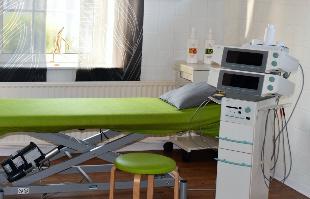
The InterX is an electrical device that provides Interactive Neurostimulation. It generates electrical pulses, which stimulate the skin at the area of pain/inflammation. This stimulation has an interactive nature: each consequent signal from the device communicate with the nervous system through the skin interface activating natural pain relieving mechanisms.
What does it do?
InterX treats PAIN when patient suffer from:
- Sport injuries (acute and chronic) – muscular spasms, sprained ankle, rotator cuff injury, shoulder impingement, tennis elbow, carpal tunnel, piriformis syndrome, muscular and ligament strains, patellar-femur syndrome, brachial plexitis, Shlatter’s, ileotibial band syndrome, Achilles tendon injuries, etc.
- Post-operative – after any surgery to manage pain, after hip/knee replacement, etc.
- Workplace related injuries (acute and chronic) – neck and lower back pain, disc problems, frozen shoulder, arthritis of the joints, facet joint syndrome..
- Neuropathic pain – trigeminal neuropathy, diabetic neuropathy, peripheral neuropathies, brachial plexitis, Complex Regional Pain Syndrome (CRPS), fibromyalgia, etc.
- Many others – headaches, migraines, Irritable Bowel syndrome (IBS), period pains.
For more information, ask our Physiotherapy team, or try the information fact sheets below.
Laser Pain Relief Therapy
What is Laser Pain Relief Therapy?
The technology utilises superluminous and laser diodes to irradiate abnormal tissue with photons; these particles of energy are absorbed by a variety of micro-molecules resulting in the conversion of light into biochemical energy. Multiple positive physiological responses are thereby initiated and normal cell morphology and function is restored.
We use the Bioflex System, so what are the advantages? It’s non-invasive, non-toxic, easily applied and it’s highly effective in the use of pain relief. It can give pain relief for such issues as soft tissue, sports injuries, ligament and tendon tears, muscle strains, tendonitis/ bursitis, repetitive stress problems, rotator cuff injuries, tennis/golfers elbow and much more! Where other pain relief methods have failed, LPRT has helped immensely.
Many patients who have experienced LPRT have found great relief when other treatment methods could do nothing to control the pain. Additionally, there are many benefits to be had when you opt for LPRT over other treatment methods for chronic pain.
Pain laser therapy is completely non-toxic and far less invasive than surgery. It is also very easily applied and highly effective in most cases. Generally you don’t have to do much to take this therapy other than show up for your appointment. The therapist then places the laser emitting machine on the part of the body where the pain is, and treatment is relatively painless. In just a short amount of time, you’ll be pain free and able to get on with your life.
Post Operative Treatment
Post Operative Treatments
Physiotherapists here at DirectPhysio4U are fully qualified in treating patients post operatively. A lot of our patients are referred to us when they are not satisfied with the outcome post surgery under the NHS once they have been discharged from hospital. Sadly, not all patients are referred to physiotherapy after their orthopaedic or spinal surgery.
Here at DirectPhysio4U, your healing starts with us. Our team are fully qualified and experienced to treat spines, shoulders, elbows, wrists, hands, knees, ankles and feet post surgery. We will liaise with your consultant or the physiotherapist who you have seen under the NHS if we require further information about your surgery and if there are protocols they would like us to follow.
Taping
Taping
Our therapists use Kinesiology tape and conventional strapping tape to help either to take pressure off the tissue or joint or to align the tissue or joint without revisiting the clinic constantly.
Kinesiology tape is thin and stretchy made of elastic cotton with an acrylic adhesive. It’s very rare that patients are allergic to this tape, hence why it is widely used. Due to its elastic properties, Kinesiology tape provides dynamic stability, which means you still have full mobility in your joints and tissues. You can still function and perform excessive amounts of training with Kinesiology tape.
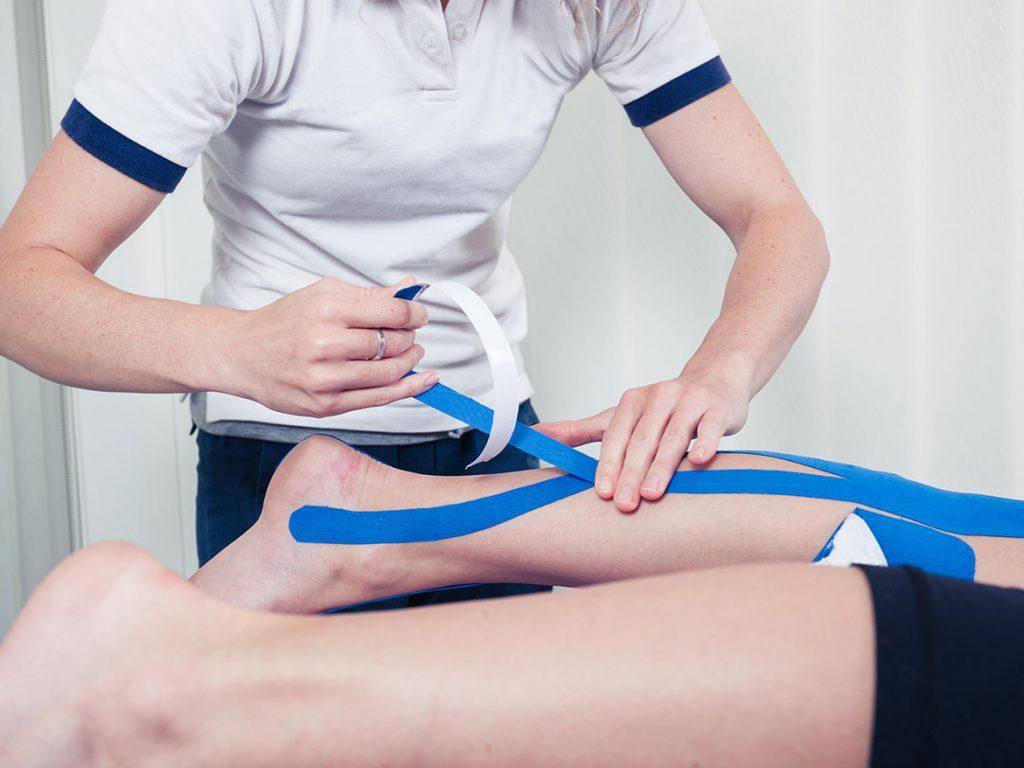
Conventional strapping tape is non-elastic and is wrapped tightly around an injured joint or muscle to provide rigid support and restrict movement. They can only be worn for short periods of time, after which they must be removed to restore movement and circulation.
Both Kinesiology taping and Conventional strapping can benefit a wide variety of musculoskeletal, sports injuries and inflammatory conditions. The tapes are used to relief pain, reduce swelling, align joints and tissues, assist in healing, assist in weak muscles and allow return to work and sports sooner than normal.
You will have noticed that more and more professional athletes use kinesiology taping improve their sporting performance, prevent injury and allow them to return to sport quicker.
Ergonomic Assessments
Ergonomic assessments
Ergonomic assessments are to prevent musculoskeletal injuries and disorders in a workplace hence providing a safe and productive environment.
Poor postures due to poor working environments and sustained positions are the leading cause of pain, suffering and disability both in and out of workplaces. If not addressed, this can lead to employees taking time off work hence poor productivity to an employer and increase costs.
What we have found is that early intervention has reduced the number of repetitive strain injuries and time off work. When we have not been able to provide early intervention, it means we then have to reassess the patient. Once this is done, we will address the root cause of the discomfort and then we advise on adapting lifestyle and work environment to prevent further injuries and regain you back to your normal function.
